
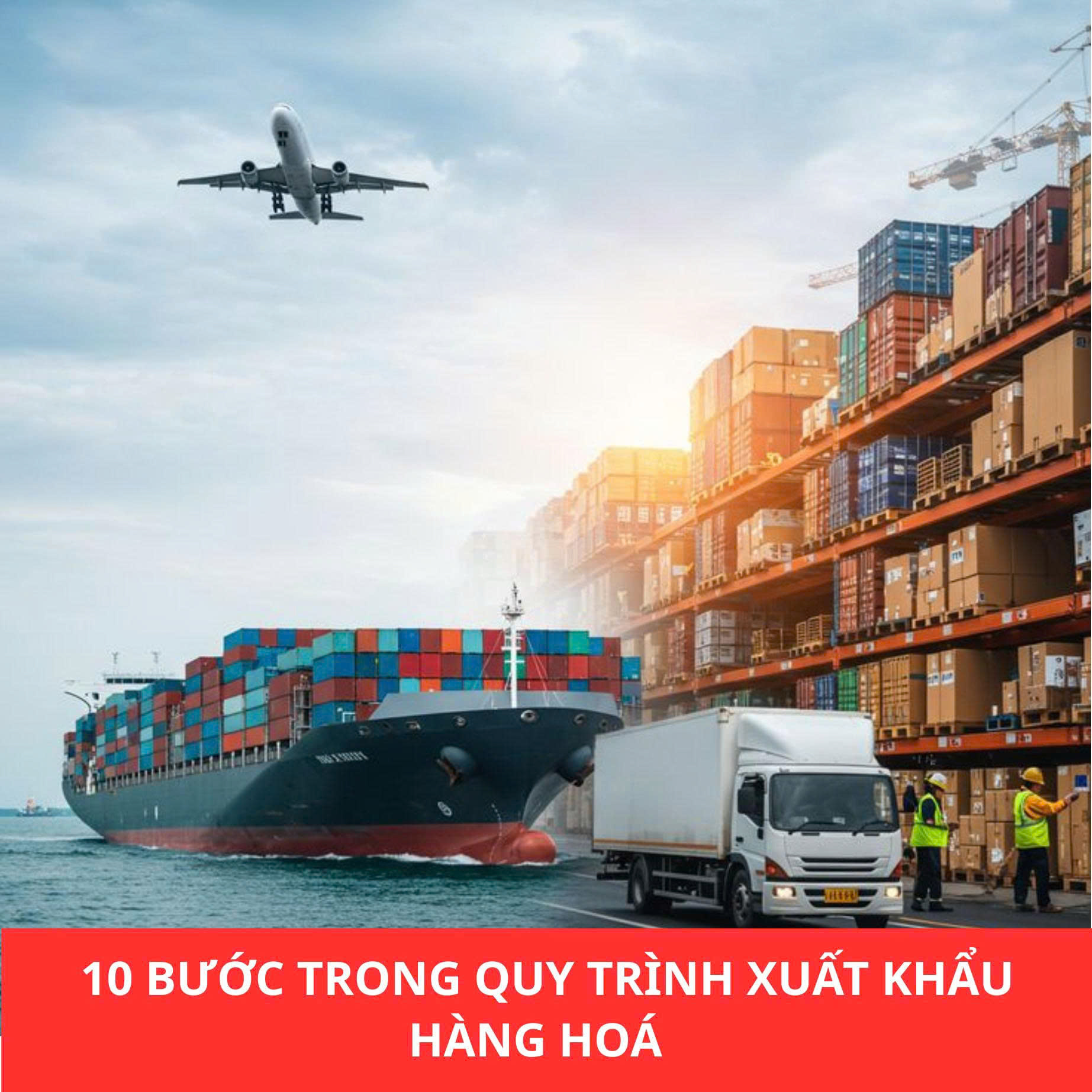
Exporting goods is a crucial activity that helps businesses expand into international markets and increase revenue. However, to ensure that shipments are cleared smoothly and delivered to partners on schedule, companies must clearly understand the standard 10-step export process. The article below provides a complete overview of each step, from contract signing to final international payment.
1. Receiving Inquiry and Sending Quotation
The export process begins when a company receives an inquiry from a foreign customer. The company will:
Analyze customer requirements
Determine delivery terms (Incoterms)
Prepare a quotation or Proforma Invoice
This step lays the foundation for negotiation and contract signing.
2. Negotiation and Signing the Sales Contract
After agreeing on the terms, both parties sign a Sales Contract covering:
Product name, specifications, and quantity
Export price
Delivery terms (FOB, CIF, etc.)
Payment method (T/T, L/C, etc.)
Delivery schedule
The contract serves as the most important legal basis throughout the export process.
3. Applying for Export License (If Required)
Certain goods such as food products, agricultural goods, wood, chemicals, etc., may require an export license or specialized inspection before customs clearance.
Businesses must carefully check regulations to avoid cargo delays or penalties.
4. Preparing and Inspecting the Goods
The company proceeds with:
Manufacturing or sourcing the goods
Quality inspection
Quantity checking
Proper export-standard packaging
If required by contract, quality inspection or fumigation must be conducted.
5. Applying for Certificate of Origin (C/O)
The Certificate of Origin (C/O) proves the origin of goods and may allow the importer to enjoy preferential tariffs under Free Trade Agreements.
Accurate HS code declaration and origin determination are essential at this stage.
6. Booking Vessel or Transportation
The company or freight forwarder will:
Contact shipping lines
Select suitable container type (20ft, 40ft, reefer container, etc.)
Receive booking confirmation
It is important to pay attention to the cut-off time to ensure cargo meets the scheduled vessel.
7. Purchasing Cargo Insurance (Under CIF/CIP Terms)
If the seller is responsible for insurance (CIF/CIP terms), the company must arrange cargo insurance to minimize risks of loss or damage during international transportation.
8. Export Customs Clearance
This is the most critical step in the export process.
Customs documentation includes:
Electronic customs declaration
Sales Contract
Commercial Invoice
Packing List
C/O (if applicable)
Export license (if required)
After submission, the system will classify shipments:
Green channel: Immediate clearance
Yellow channel: Document inspection
Red channel: Physical inspection of goods
9. Cargo Delivery and Bill of Lading Issuance
After customs clearance:
Cargo is transported to the port
Container gate-in procedures are completed
Cargo is loaded onto the vessel
The shipping line issues the Bill of Lading (B/L), an essential document for cargo release at the destination port.
10. International Payment and Document Submission
Depending on the payment method:
T/T: Buyer transfers payment as agreed
L/C: Seller submits documents to the bank
The document set usually includes:
Invoice
Packing List
Bill of Lading
C/O
Other documents as required by contract
Once this step is completed, the export process is finalized.
11. Benefits of Understanding the Export Process
Clearly understanding the 10 steps in the export process helps businesses:
Minimize legal risks
Reduce storage and container detention costs
Ensure on-time delivery
Optimize international business performance
👉 If your company is preparing for export or needs detailed consultation on procedures and documentation, contact us today for fast, accurate, and cost-effective support for each shipment.